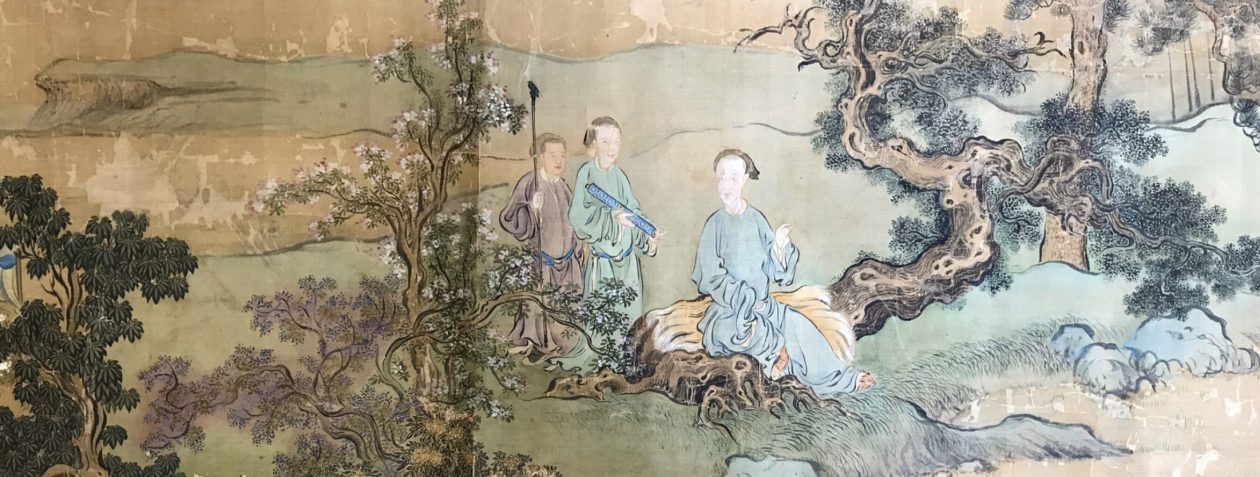
There is another form of existence: to sever oneself—cleanly, without residue—from the body of society.
Not retreat, but rupture. Not resignation, but refusal.
The world names it “retirement.”
In truth, it is exile by one’s own hand: a deliberate abandonment of the herd, in order to live alone—answerable to nothing but one’s own taste.
No longer does one crawl before the idol of usefulness.
No longer does one beg for meaning by serving the needs of others.
One turns away—coldly—from this economy of justification.
Instead, one founds oneself within the so-called culture of living: a domain that does not serve, does not justify, does not redeem.
It simply is—a sovereign territory of form, sensation, and self-creation.
Production. Reproduction.
These are the labors of the species—mechanisms of its blind will to persist.
Let them belong to the many.
What remains—what is higher—is without purpose.
It does not contribute. It does not advance. It does not explain itself.
It is the excess of life over necessity: the refinement of existence into something willed for its own sake.
This is what the timid call “play.”
But play, in its pure form, is not trivial—it is tyrannical.
It obeys no law beyond its own intensity.
It exists because it must exist, because it affirms itself.
The cultivated classes of the Edo period once knew this, and called it yūgei—disciplined frivolity, perfected uselessness.
Art belongs here. Ritual belongs here. Even the most fleeting amusements—yes, even something like Pokémon GO—can, in their purified form, be transfigured into this domain.
I spiraled down a path of addiction, starting with gambling and progressing to addiction to Filipino pubs, alcohol, and dating cafes. With the exception of my addiction to sex, I was able to break free from my addictions through hitting rock bottom, returning to society and becoming indifferent to my former targets. I became a believer in the “bottomed out” approach, which involves pouring all of one’s money, time, and physical energy into facing one’s addiction head on. I believed that this approach would work for overcoming my final addiction, and by October of 2021, I had converted to this “bottomed out” approach.
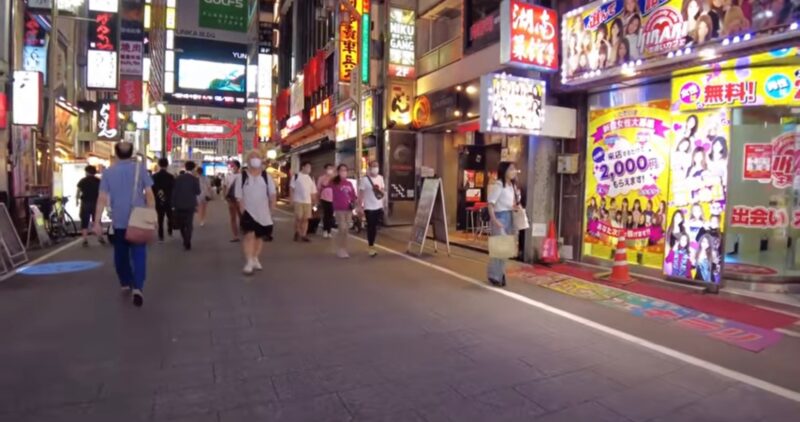
I devoted all of my energy to pursuing my own methodology, based on my own experience, and aimed for the final destination of “bottoming out.” I locked myself in the Kabukicho entertainment district, doing as I pleased, and felt that even if I barely survived, it would be better than nothing. However, this way of thinking itself was foolish, reckless, and perhaps even a biological, fundamental instinct of a male to contain the addiction of sex. It was inappropriate to believe that I could overcome this addiction by sheer force. Ultimately, my last addiction felt like a bottomless swamp, with the bottom seemingly far away, or maybe the concept of a bottom was not appropriate at all. I was drawn to a fleeting desire for a state of being that didn’t exist. Such endless delusions and intense desires are surely a type of mental illness.
But, fortunately, I was able to avoid a complete mental breakdown and loss of willpower that would have led to homelessness and instead interacted with young people without developing fatal troubles. I must have been lucky. Although I didn’t reach the sensation of bottoming out, I was left with a feeling of “I’ve had enough.” I continued to run through the night streets in search of the orgasm of my heart, even as I suffered from prostatitis and almost collapsed from exhaustion. This was like continuously stepping on the accelerator pedal, even as the engine burned out in a car. The feeling still smolders deep inside me.
He still remembers the scene very well on a day of spring cool breeze, hot sunny day. There were 20 men customers who were desperately searching for temporarily lover as one night pleasure, standing in the hall at cafe called “Endless Despair”, looking at the girls with “Eye of the Dead Fish”. Jimmy also used to be just one of them before. 17 young girls were just waiting for somebody ask her to go outside for “Date” with earning some money. One day she was sitting at the seat of No. 18, to the corner of secret membership cafe, especially attending on the weekend, wearing summer clothes, waiting for somebody to talk. Jimmy noticed that she gave many rejections to the lonely guy customer who asking her to have a date with. God only knows why that she had done to do so. She kept watching her own iPhone vaguely with gloomy face while maybe she was typing something for LINE. Unlike another girls, she never ever took the light snack, kind of chocolate, candy, potato chip which equipped at the cafe. Suddenly her intellectual and sophisticated atmosphere strongly attracted Jimmy’s deadly wounded fragile weak heart. She could not see anybody guys from her women side through “special mirror glass”. But he could see her very well from mens side by see-through glass, she was well recognized from her head to toe except her face under the mask. Instinctively he felt that it was the high time to say “Hello” to her. ”Now or Never”..whispering in his mind, secretly.
Falling Love at “First Sight”
Sometimes, at somewhere, there is probability..
It may happen to anybody..
Trying to survive with those sweet REMINISCENT, once 256 angels came down from the heaven to save his life, however they had gone with the wind, suddenly vanished without saying anything.
On July 4, 2019, in Ueno’s Ameyoko, I happened upon a sign for a meeting café called Kirari. From that first accidental encounter until the end of December 2021, I passed through the lives of 289 young women, mostly university students around the age of twenty, many of them sustaining themselves through what is euphemistically called papa-katsu in order to repay their student loans.
I plunged headlong, relentlessly, to the very limits of endurance. When I finally broke, it felt as though my mind and finances had been blown apart by dynamite, reduced to scattered fragments. At the same time, every relationship surrounding me, professional and private alike, collapsed in all directions. I self-destructed completely.
Before I ever knew this world, I regarded media reports on “impoverished young women” or “college students in the sex industry” as stories about people inhabiting a universe utterly unrelated to mine. The phenomenon called papa-katsu, framed as a new youth culture or social symptom, was foreign territory to me. I doubted such reports: could academically capable university students truly turn to selling sex, even under financial strain? And yet, my curiosity, my desire to see the reality with my own eyes, was unusually strong. At the same time, I was, quite simply, interested in young and attractive female students, though I had no idea how to enter that world.
Looking back, my life had already traced a cycle of gambling addiction, collapse, rebirth; alcohol addiction (including an obsession with Philippine pubs), collapse, rebirth. Within the so-called male triad of desires—drink, gamble, buy—I had already experienced enough agony in the realm of “buying,” of commercial sex. Still, at fifty-eight, nearing sixty, I opened a Pandora’s box I had no need to open: an extraordinary, unnecessary world.
My abnormal fixation on the female students who frequented meeting cafés, and the violent sexual impulses that accompanied it, spiraled beyond any restraint. I found myself sliding day by day into a bottomless swamp, accelerating toward becoming a social ruin, incapable of sustaining ordinary life. In desperation, I sought help at Enomoto Hospital in Ikebukuro, the only medical institution in Japan specializing in sexual addiction. I was diagnosed with “compulsive sexual addiction,” attended several self-help groups, and underwent rehabilitation programs.
Yet I could not believe that their treatment policy—absolute abstinence, prohibition of masturbation, strict avoidance of entire city zones associated with meeting cafés (Ueno, Ikebukuro, Shinjuku, Shibuya, Omiya, Yokohama, Kawasaki), and the declaration that any sexual activity outside marriage or a committed relationship was immoral—could possibly cure my addiction. I am a four-times-divorced man with no partner. From morning to night, I was assaulted by burning compulsive fantasies: If I go now, a fated encounter with an angelic college girl must be waiting. Don’t hesitate. Go immediately. I could not resist them.
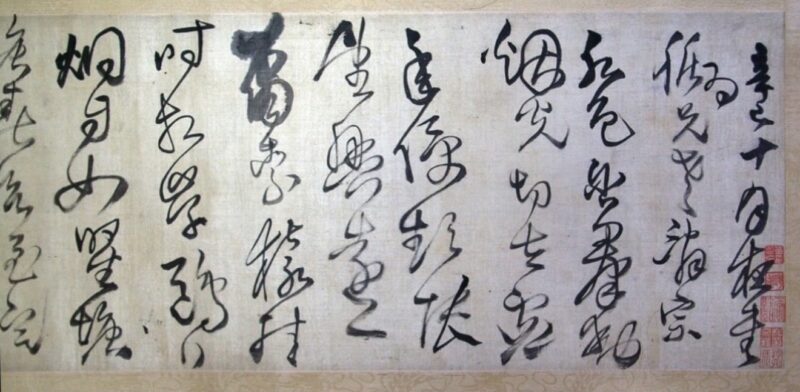
Slowly, I consumed the 12 million yen I had earned trading Chinese hanging scrolls. I lost all interest in appraising artworks or collecting treasures as a dealer in Chinese calligraphy and painting. Concentration became impossible. Dimly, I sensed that this intense sexual addiction and the resulting collapse of my life were unavoidable. I had survived three cycles of ruin and rebirth before, but a fourth collapse, at my age, felt final. If I fell into the swamp again, I knew I would never climb out. An endless, opaque despair began to stain my thoughts.
By October 2021, I was like a terminal drug addict beyond control. Sleepwalking, I gathered 4.5 million yen from bank loans and three consumer lenders, holed up in my favorite Kabukicho love hotel, LISTO, and indulged endlessly in desire for young women from morning until night. On good days, I met four women a day. By then, I had entirely lost interest in orgasm itself. I believed, desperately, that the longer I remained physically fused with someone, even for a second, the more I could escape my fear of collapse and death. I trembled at the thought of the final moment.
In Kabukicho, each second felt like the climax of my life. The city seemed drenched entirely in pink. I often met women beneath the TOHO building, beneath the giant Godzilla head. I was so consumed by the women that I failed to notice it for some time. When its roar finally drew my gaze and our eyes “met,” I felt an inexplicable embarrassment, a sudden shame, as if jolted back from complete escapism. That moment still feels like yesterday.
After spending every last yen, I told myself that only by throwing myself onto the Saikyo Line—the railway I used most frequently—and annihilating both myself and the uncontrollable beast of desire nesting inside me could salvation exist. I wandered straight toward death, groaning like a dying animal.
As expected, I became penniless, unable even to pay utilities, trembling before debt collectors. Searching blindly for an exit—or an end—to terminal sexual addiction, I lay unable to rise. In that instant, I devoured your books: Sex Wanderings and your other “pathological” works.
Your words were magical. They soaked into me like water into a vast desert. It felt as if every line entered my veins via an IV drip and danced through my bloodstream. In my dopamine-saturated brain, your texts acted like a seal on desire, freezing the neural command center that launched sexual impulses. My brain was gently paralyzed, resuscitated, and given rest. I lay beneath the futon, unable to move, as if hallucinating my gradual return to a rational mind.
At the same time, I found the emotional space to look back on my own wandering through meeting cafés.
Thank you.
With gambling and alcohol addiction—specifically my addiction to shochu Kinmiya—I fought my obsessions head-on, pouring money and time into them until they exhausted themselves and lost all meaning. Through that experience, I came to understand “hitting bottom” as something felt viscerally, not abstractly. That is why I became deeply interested in the relationship between the sensation of bottoming out and one’s inner state.
Those three months in Kabukicho, from morning to night, living as a beast incarnate among angels, may have brought me closest to the bottom. The book that revealed this to me, the one that became my Bible, was your Sex Wanderings.